
The Mistral AI Phenomenon: How a French Startup Is Redefining Frontier AI
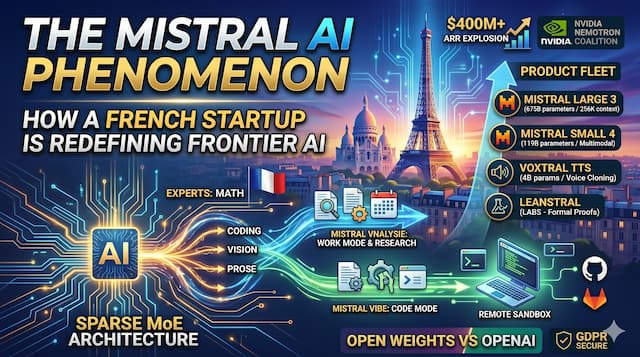
If you want to understand the competitive tension of the global AI landscape, you only need to look at a single company based in Paris: Mistral AI.
Founded in mid-2023 by alumni from Meta and Google DeepMind, Mistral accomplished what many thought impossible—competing directly with multi-billion-dollar American tech monopolies while keeping its team remarkably lean.
The strategy has paid off massively. By early 2026, Mistral AI’s annualized recurring revenue (ARR) skyrocketed from roughly $20 million to over $400 million, putting the company firmly on track to exceed $1 billion by the end of the year. Valued at nearly $14 billion, Mistral is no longer just an alternative; it is an absolute enterprise juggernaut powering clients like ASML, TotalEnergies, and HSBC.
But how exactly does Mistral work, and what makes its models so uniquely disruptive? Let’s break it down.
1. The Core Secret: Sparse Mixture of Experts (MoE)
Mistral’s rise to fame began when they pioneered the commercialization of the Sparse Mixture of Experts (MoE) architecture.
To understand MoE, imagine a traditional dense AI model (like standard GPT variations) as a massive corporate office where every single employee must review and sign off on every simple email that comes through the door. It is incredibly thorough, but painfully slow and massively expensive in terms of computing power.
Mistral’s Sparse MoE acts like an intelligent router:
                  [ USER PROMPT ]
                         │
                         ▼
             [ GATING/ROUTING NETWORK ]
             ⚡ (Only activates 2 experts)
            /     │      │     \
           /      │      │      \
    ┌─────────┐┌─────────┐┌─────────┐┌─────────┐
    │ Expert  ││ Expert  ││ Expert  ││ Expert  │
    │  Math   ││ Coding  ││ Vision  ││ Prose   │
    └─────────┘└─────────┘└─────────┘└─────────┘
When you prompt a model like Mistral Large 3, which boasts a staggering 675 billion total parameters, the model doesn’t run the whole engine. Instead, its internal gating network selectively activates only the two specialized “experts” best suited for the prompt, utilizing just 41 billion active parameters per token.
The Business Benefit: You get the deep intellect of a 675B parameter model, but with the lightning-fast processing speeds and drastically reduced computing costs of a much smaller model.
READ ALSO: Beyond Silicon Valley: The Rise of European ChatGPT Alternatives in 2026
2. The 2026 Product Fleet: “Vibe Gets to Work”
In mid-2026, Mistral officially phased out its original consumer application, Le Chat, replacing it with Mistral Vibe—a unified agent ecosystem built for long-running, multi-step workflows. Vibe natively spans across two distinct interfaces:
💼 Work Mode
Designed for corporate operations, Work Mode operates as an autonomous workspace. It can sync directly with your enterprise inbox and calendar, execute multi-document synthesis, and handle complex background research autonomously. You can even program it to run recurring tasks on a daily or weekly schedule.
💻 Code Mode
Code Mode transforms Vibe into an autonomous software engineer. It operates inside an isolated, cloud-hosted remote sandbox where it can write, execute, refactor, and test full code repositories. With its dedicated VS Code extension, it works alongside human developers, directly filing reviewable pull requests via GitHub or GitLab.
3. The Flagship 2026 Model Grid
Mistral categorizes its technology into highly optimized tiers, allowing enterprises to choose the exact scale of intelligence they require:
Mistral Large 3 (Open Weights): The flagship heavyweight. Featuring a massive 256K context window and fully integrated multimodal vision capabilities, it handles dense enterprise databases with ease.
Mistral Small 4 (Open Weights): Released in March 2026, Small 4 is an architectural marvel that merged three previously independent specialized models (Magistral for reasoning, Pixtral for vision, and Devstral for agentic coding) into a single, cohesive 119B MoE powerhouse. It clocks an output speed of 137.3 tokens per second.
Voxtral TTS (Open Weights): Mistral’s aggressive expansion into voice. A state-of-the-art text-to-speech engine that can pull off highly accurate, zero-shot voice cloning across 9 languages using as little as a 3-second audio sample.
Leanstral (Labs Project): A specialized, niche code agent tailored explicitly for Lean 4 formal proof engineering, designed to mathematically verify that its generated code is flawlessly accurate before deployment.
READ ALSO: The Sovereign Blueprint: Europe’s Open-Source AI Revolution in 2026
How Mistral Makes Money: The Monetization Engine
A common question surrounding open-weight companies is how they achieve profitability when their raw model code can be downloaded for free on Hugging Face. Mistral relies on a highly effective three-pronged monetization flywheel:
Commercial API Access (Mistral Studio): For teams that don’t want to manage their own cloud servers, Mistral charges competitive, utility-based pricing for accessing their flagship models via cloud API endpoints.
Mistral Forge & Enterprise Infrastructure: Large banks, defense groups, and governments pay significant enterprise fees to use Mistral Forge. Forge allows these entities to securely pre-train and fine-tune Mistral’s open weights on their own highly sensitive, air-gapped server stacks.
The NVIDIA Nemotron Coalition: By partnering directly with hardware giants like NVIDIA, Mistral co-develops industry-standard foundation models, ensuring their software is completely optimized for the next generation of data center GPUs.
The Takeaway
Mistral AI has proven that tech sovereignty doesn’t require mirroring Silicon Valley’s massive, data-hungry, centralized approach. By focusing on architectural efficiency through Sparse MoE, prioritizing developer flexibility via open weights, and leaning heavily into enterprise security compliance, Mistral has cemented itself as an irreplaceable pillar of global AI infrastructure.
Enjoyed this? Get the week’s top France stories

One email every Sunday. Unsubscribe anytime.

