
Why the Combat Outfits of the French Army will Perhaps no Longer be “100% European”
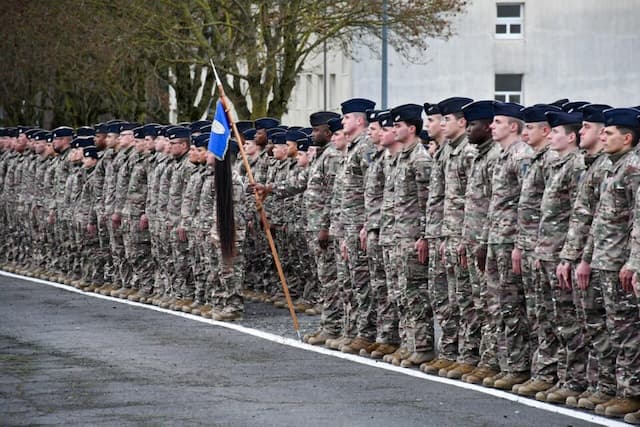
Currently woven in France and made in Europe, the French military’s fatigues are the subject of a new call for tenders, certain rules of which raise questions.
And if the combat outfits from l’french army were no longer made in Europe? At a time when questions from industrial sovereignty permeate public debate, one tender the Ministry of the Armed Forces raises questions –not to say concerns – in the textile sector.
Combat outfits: a market worth 485 million euros
According to the consultation regulations including Current surveys was able to take note, the candidate companies have until Wednesday 3rd December 2025 to submit their proposals. At stake, five prizes (F3 combat gear, Overseas effects, head effects and accessories, wetsuits, mountain combat gear) which will each be the subject of a framework agreement for a period of seven years.
The most important of these lots concerns F3 combat outfits (lot n°1). Its maximum amount excluding taxes is estimated at 485 million euros. In detail, the estimated orders relate to 1.5 million shirts, 1.6 million pants or again 500,000 suspenders.
All in the colors of ” multi-environment coloring ” (BME). This is a new camouflage, designed to “better protect our soldiers whatever the environment”, summarizes the Ministry of the Armed Forces in a presentation video posted last January on the social network
[1/4] Mieux protéger nos soldats quel que soit l’environnement : c’est l’objectif du nouveau treillis F3 au bariolage multi-environnement. Voici un aperçu 👇@armeedeterre @DGA @SCArmees @Stat_20e_ra pic.twitter.com/FdppJmYQuX
— Ministère des Armées et des Anciens combattants (@Armees_Gouv) January 16, 2025
“European preference”
“The BME, woven in France, is 100% European! “, welcomed in February the senior general commissioner Olivier Marcotte, responsible for military clothing, in a interview published on the ministry website.
Thus, the manufacturing of the fabric currently falls to two French companies (TDV in Mayenne and Europrotect in Lyon) and a Belgian (Utexbel), while the next step, that of making the trellis, is carried out by two Bulgarian companies (Transconfection and Karo-06) and another Belgian (Seyntex), reports on his blog Philippe Chapleau, journalist specializing in daily defense issues West France.
The choice of these suppliers, all located on the Old Continent, owes nothing to chance:
For combat effects (such as the new F3 BME trellis) or personal combatant protective equipment (NRBC*, ballistics, flight outfits…), we have a strategy for securing our supplies, thanks to the principle of European preference.
In line with this purchasing policy, the previous call for tenders for the manufacture of combat outfits F3, passed in 2017, required that all means of production (place of manufacture, tools, materials and technical equipment…) be located on the territory of the’European Union “, we can read in the application selection procedures.
“The contract was reserved for Europe”, confirms Roland Tougayere, French manager of the Bulgarian company Transconfection which today holds “a large part of the market”. But the current consultation could reshuffle the cards.
“If production went to Asia…”
Although it is only open to companies “from the European Union (EU) or the European Economic Area (EEA)”, the procedure is not binding this time no geographic restrictions at the places where F3 BME combat gear is made. They may be located in Europe and/or in third countries. In other words, the five service providers selected for this lot following the call for tenders will necessarily be European, but they will be able to respond to the market by employing factories located elsewhere in the world.
With this change of rule, Roland Tougayere fears losing the battle price who counts for 30% of the final grade (50% for the quality, 10% for the security conditions of the fabric delivered by the administration and 10% for the sustainable development component).
“Our file is 100% European, we will not be able to fight against competitors who manufacture in Asia or Madagascar”, says the boss of Transconfection, whose activity is entirely focused on the French army. “If we miss each other, 800 people who work directly for us or our manufacturers risk being left behind. “
Beyond his Bulgarian workshops, the manufacturer is worried about the future of his french and European suppliers : If production went to Asia or elsewhere, there would no longer be any reason to source the small accessory in Europe, because of customs duties, logistical constraints, price… Lots of people who worked with us would be impacted. “
Security of supplies?
Manufacturer of technical fabrics in Saint-Romain-de-Popey (Rhône), northwest of Lyon, Textile Balas provides meshes, an accessory but nevertheless strategic part of combat outfits, since they are aux pieces very special performances (fire-fighting and infrared materials)”, underlines its president Olivier Balas.
The company operates “with subcontracting, only on French territory”. Its activity thus generates “more than 250 jobs direct and indirect in Rhône-Alpes.
In relation to the concerns expressed by Roland Tougayere, the Rhone entrepreneur recalls that the armies obtain fabrics as part of a separate market. It would therefore not be directly impacted by a change of service providers in the making of combat outfits.
However, “it is not said that these meshes cannot be purchased elsewhere”, admits Olivier Balas who questions “the security of supplies”, in a world where “conflicts, military and economic standoff are getting stronger and stronger.
We should produce in Europe for the needs of our armies, avoiding third countries which tomorrow will not necessarily be our friends.
On condition of anonymity, another French textile player believes that “producing in Morocco or Tunisia is perhaps today less risky than in Bulgaria or Romania, with the proximity of the war between Ukraine and Russia “.
And added: In thinking about its purchases, the Ministry of the Armed Forces integrates the strategic factor, not just the economic factor. That’s a lot of outfits to produce, maybe there’s the will to’expand supplies to equip the forces as quickly as possible. “
The response from the Ministry of the Armed Forces
Attached by Current surveys, the ministry indicates that the army police station, responsible for the clothing function, ensures that it maintains a balance between several objectives 1 supply sovereignty forces, particularly for operational effects; THE support for the defense industrial base, by bringing together SMEs, mid-sized companies and European partner companies; and there economic security of sectors, which requires operators with sufficient financial and industrial capacities to guarantee continuity of service and quality of production.
Furthermore, “the army Commissariat passes a third of clothing contracts under the defense and security contracts regime for which “the principle of European preference prevails”, in accordance with public procurement law.
“Also, for the current procedure, the principle of european preference is always a criterion of appreciation “, we are assured. Certain items in the call for tenders –mountain outfits, flight suits, hats, mosquito nets – require manufacturing in Europe. Which is not the case for lot n°1, that of the F3 BME combat outfits.
Why this difference? The Ministry of the Armed Forces did not wish to go into further detail about the procedure, given the need to “[guarantee] each company fair and confidential treatment until completion”.
Modem MP for French people established in Germany, Central Europe and the Balkans, Frédéric Petit also questioned the ministry on the rules of its call for tenders. At the time of writing, the parliamentarian indicates that he has not received a response.
*nuclear, radiological, biological and chemical.
Enjoyed this? Get the week’s top France stories

One email every Sunday. Unsubscribe anytime.

