
The Sovereign Blueprint: Europe’s Open-Source AI Revolution in 2026
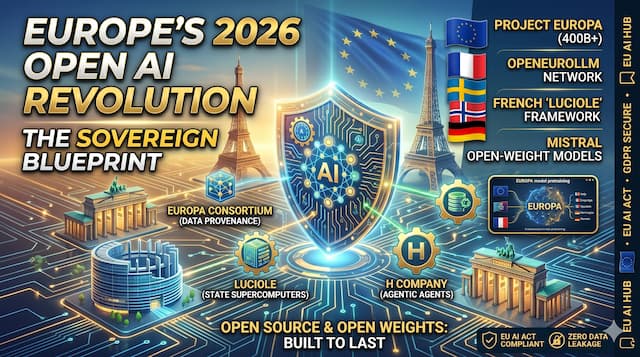
The Sovereign Blueprint: Europe’s Open-Source AI Revolution in 2026
When the history of artificial intelligence is written, 2026 will be remembered as the year Europe codified AI infrastructure as a public good.
For years, critics claimed Europe was falling behind in the global AI race, hampered by strict regulations like the EU AI Act. However, that regulatory framework has unexpectedly become the continent’s greatest competitive advantage. By demanding absolute data provenance and corporate auditing, Europe has triggered a massive, multi-national shift toward open-source and open-weight models.
Instead of building proprietary, locked-down digital ecosystems, European nations, startups, and consortia are treating foundational AI like open roads and clean water—collaborative, transparent, and structurally sovereign.
Here is how Europe is redefining open-source AI in 2026.
1. Project EUROPA: The Multi-Lingual Behemoth
In June 2026, the European Commission fundamentally altered the AI landscape by selecting the EUROPA consortium (led by Domyn) as the winner of its high-stakes Frontier AI Grand Challenge.
The Vision: Funded to build a true frontier-tier European open-source model natively from the ground up.
The Scale: Designed at a massive scale exceeding 400 billion parameters.
Linguistic Equality: Unlike Silicon Valley models that view non-English languages as secondary translation layers, EUROPA natively covers all 24 official EU languages with equal mathematical weight, ensuring true linguistic democracy for public institutions and enterprises alike.
“Europe can lead in advanced AI on its own terms,” noted Henna Virkkunen, EU Executive Vice-President for Tech Sovereignty, Security and Democracy, upon the launch. “This is about strengthening Europe’s ability to shape AI’s future with openness, trust and strategic autonomy at its core.”
2. OpenEuroLLM: The Continental Network
While single companies chase valuations, the OpenEuroLLM project has united Europe’s leading academic institutions and computing centers (including major contributions from AI Sweden and the University of Oslo) to build a collaborative stack of sovereign foundation models.
┌────────────────────────────────────────────────────────┐
│               OPENEUROLLM CORE FOCUS AREAS             │
├───────────────────┬────────────────────────────────────┤
│ 📂 DATA PIPELINES │ • EU AI Act compliant data sourcing│
│                   │ • Fully transparent pretraining    │
├───────────────────┼────────────────────────────────────┤
│ 🛡️ BENCHMARKS     │ • Cross-lingual alignment testing  │
│                   │ • Rigorous local safety guardrails │
└───────────────────┴────────────────────────────────────┘
OpenEuroLLM’s primary contribution to the ecosystem is its radical transparency. Every intermediate training checkpoint, anonymization pipeline, and dataset blend is published openly on Hugging Face. This allows strict enterprise compliance officers to trace the exact lineage of a model’s intelligence, fulfilling the strict transparency requirements mandated by European law.
3. The French “Luciole” Framework & Jean Zay Supercomputing
France has rapidly positioned itself as the physical factory of European open-source AI. Powered by state-of-the-art architectures like the NVIDIA Blackwell platform, national infrastructure is turning theoretical research into active production reality.
Central to this is the OpenLLM-France project, which recently launched the Luciole model family (ranging from compact 1B models up to robust 23B parameter variations).
Sovereign Computing: Luciole was trained entirely on Jean Zay, one of Europe’s most powerful and eco-efficient supercomputers.
Clean Data: By training exclusively on transparent, well-documented, public-domain datasets, Luciole completely bypasses the copyright lawsuits plaguing American developers, making it a safe choice for risk-averse European corporations.
4. Mistral AI & The NVIDIA Nemotron Coalition
Though Mistral AI has successfully scaled its commercial monetization via its Vibe interface, it remains deeply tied to its open roots. As a founding member of the NVIDIA Nemotron Coalition, Mistral actively collaborates on advancing open frontier systems.
Mistral’s Open-Weight 2026 Contributions:
Mistral Small 4 (119B parameters): An Apache-2.0 licensed Mixture of Experts (MoE) model that accepts text and images natively, optimized heavily for edge-cloud deployments.
Voxtral TTS (4B parameters): A highly flexible, open-weights text-to-speech model capable of zero-shot voice cloning across several European languages.
Devstral 2 & Leanstral: Specialized open-weight models built explicitly to handle code compilation and automated mathematical verification.
Why Open Source Is Winning Europe
For European enterprises, choosing an open model isn’t an ideological statement—it is a strict business necessity:
Auditability: Under the EU AI Act, black-box APIs hosted in the US present ongoing regulatory compliance risks. Open-source weights allow codebases to be audited locally.
True Air-Gapping: Critical infrastructure, defense, and healthcare applications require models to run entirely on-premises without an internet connection. Open-source models make this possible.
Cost-Efficiency & Customization: Startups like H Company are leveraging open bases to build Holotron, an advanced family of agentic software models. By starting with open-weight foundations, they bypass the multi-billion-dollar cost of base pretraining.
Summary
The European open-source AI strategy of 2026 proves that you don’t need a single, dominant monopoly to build world-class technology. By leaning into cross-border collaboration, absolute compliance, and native linguistic diversity, Europe has created a resilient, decentralized AI ecosystem that is built to last.
Enjoyed this? Get the week’s top France stories

One email every Sunday. Unsubscribe anytime.

